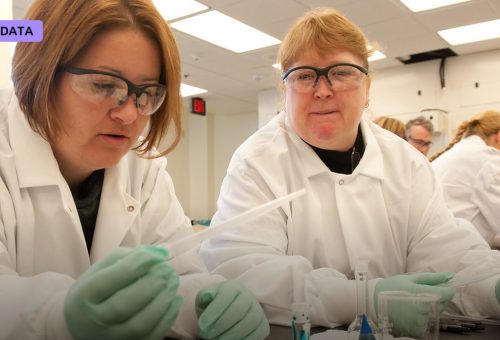
Recursion Pharmaceuticals disclosed in its second-quarter 2026 earnings release that its AI-designed candidate REC-7735, an inhibitor targeting a specific mutant form of the cancer-driving protein PI3Kα, went from a first novel chemical hit to a cleared Investigational New Drug application in just 10 months — a compressed timeline the Salt Lake City-based company says demonstrates the real-world speed advantage of its AI-native drug design platform. The company says REC-7735 was built from 242 candidate compounds screened by its machine-learning models and shows more than 100-fold selectivity for the H1047R mutant form of PI3Kα over the normal, wild-type version of the protein — a precision that matters because PI3Kα mutations of this type drive a meaningful share of solid tumors, and selectivity for the mutant form over the healthy protein is what should, in theory, reduce side effects compared with older, less targeted PI3K inhibitors. A Phase 1/2 trial called ZINNIA is expected to begin in the second half of 2026.
From Cell Imaging to Clinical Candidates
Recursion built its reputation, and much of its roughly $600 million-plus in public and private funding over the years, on a drug-discovery approach rooted in automated microscopy: robots capture millions of images of cells exposed to different genetic and chemical perturbations, and machine-learning models learn to read patterns in those images that correlate with disease biology. REC-7735 represents a shift toward a more conventional structure-based AI design process — using models to predict which molecules will bind selectively to a specific mutant protein — reflecting the company’s broader push, under newly appointed Chief AI Officer Hoifung Poon, a 15-year veteran of Microsoft’s biomedical AI research, to combine its image-based biology platform with more traditional computational chemistry.
Big Pharma Is Already Paying for Access
Recursion’s claims about speed matter commercially because the company has structured major partnerships around delivering exactly that kind of efficiency to larger drugmakers. Under a collaboration with Roche’s Genentech unit covering up to 40 small-molecule programs, Genentech recently exercised its first Validated Target Option to advance an undisclosed neuroscience target into early discovery, and Recursion has collected $216 million in upfront and milestone payments from that partnership to date, with each individual program carrying potential milestones above $300 million plus royalties. A separate collaboration with Sanofi spanning immunology, inflammation and oncology has generated $134 million in payments so far, with Recursion projecting a potential development candidate or late-stage discovery milestone from that partnership within six to 12 months.
The Bull Case: Speed Compounds Across a Portfolio
Recursion CEO Najat Khan has described the company’s approach as translating “unique data into potential first-in-class therapeutic opportunities,” and the pitch to investors and pharma partners alike is that a 10-month hit-to-IND timeline, if it can be repeated across programs, meaningfully undercuts the traditional three-to-five-year discovery phase most drug candidates require before they ever reach a clinical trial — compounding savings across the company’s full pipeline, which also includes REC-4881 for the orphan disease familial adenomatous polyposis, now in a Phase 2 trial with Orphan Drug and Fast Track designations, and several earlier-stage candidates targeting RBM39, CDK7, MALT1 and LSD1.
The Skeptics’ Case: A Cleared IND Is Not a Working Drug
A fast design timeline says nothing about whether REC-7735 will actually benefit patients — that question won’t be answerable until the ZINNIA trial produces safety and efficacy data, and Recursion’s own financial disclosures underscore how much runway that will require: the company reported a $131 million net loss for the quarter and cash reserves of $556.8 million as of June 30, down from $753.9 million six months earlier, even after lowering its 2026 operating expense guidance. The company says that cash should last into early 2028 without additional financing, but biotech history is littered with molecules that moved quickly into Phase 1 only to fail on safety or efficacy grounds that no amount of design-phase speed could have predicted.
What’s Next
The ZINNIA trial’s start later this year will be the first real test of whether Recursion’s speed claim translates into clinical results, while REC-4881’s Phase 2 data, due for presentation at the CGA-IGC Annual Meeting on November 2, offers a nearer-term readout on a different part of the pipeline. For an industry still searching for its first unambiguous proof that AI-accelerated discovery produces drugs that work as well as, or better than, those found the traditional way, Recursion’s partnerships with Roche and Sanofi suggest at least two of the industry’s largest drugmakers are willing to keep paying to find out.
Photo: Tima Miroshnichenko / PEXELS via Pexels