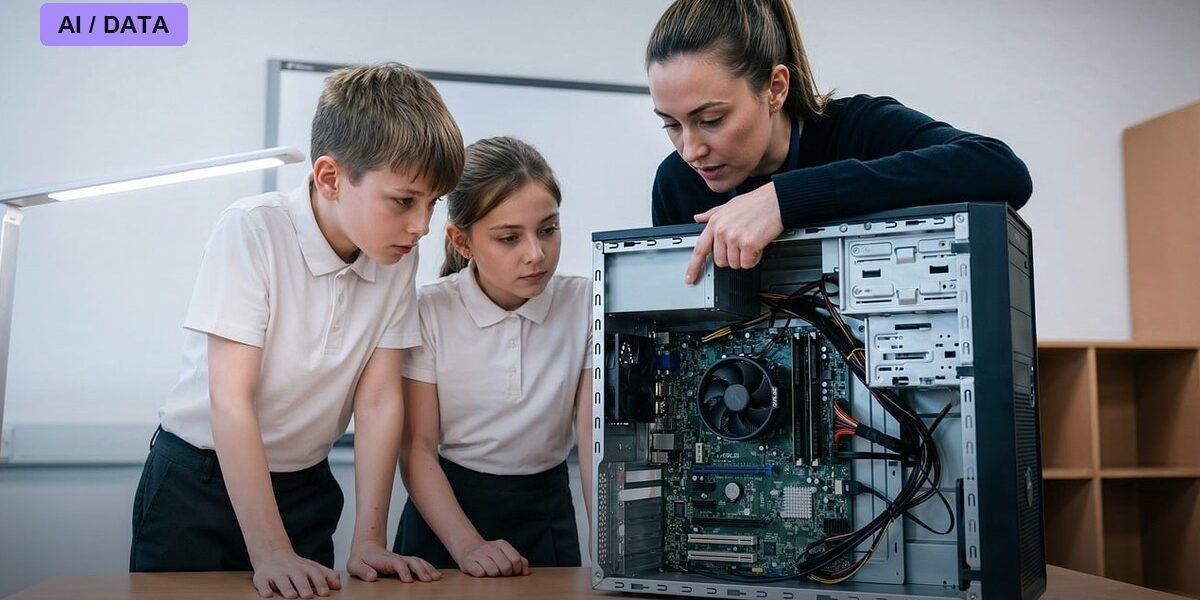
A joint study from the Walton Family Foundation and Gallup found that 32% of US teachers used AI tools at least weekly in 2026, with those teachers reporting an average time savings of 5.9 hours per week — roughly a full workday reclaimed from lesson planning, grading, and administrative tasks. At the same time, 40% of teachers reported not using AI tools at all, underscoring how unevenly the technology has spread across American classrooms.
What Teachers Are Actually Using AI For
The most common applications cited in classroom-technology commentary include adaptive learning platforms such as Khanmigo and DreamBox, which adjust lesson difficulty in real time based on individual student performance, alongside AI-assisted grading tools and accessibility features like real-time translation and automated captioning for students who are deaf or hard of hearing or who are English-language learners.
Students Are Using It Even More
Survey data on student AI use varies by source but consistently shows high adoption: Pew Research found 54% of US teens had used AI chatbots for help with schoolwork, while Common Sense Media put the figure closer to 70%. That gap between student and teacher adoption rates — with students arguably ahead of the educators assigning and grading their work — has become a central tension in how schools are approaching AI policy.
The Academic Integrity Problem Hasn’t Gone Away
Widespread student use of AI tools for schoolwork has intensified longstanding concerns about academic integrity, cheating detection, and what it even means to assess genuine learning when a chatbot can produce a passable essay or solve a math problem in seconds. Schools have responded with a patchwork of policies — some banning AI outright for certain assignments, others integrating it directly into curricula and teaching students how to use it as a tool rather than a shortcut — with no clear national consensus yet on the right approach.
Educators Want to Stay in Control
Commentary from school administrators consistently emphasizes that teachers want AI to support their work without displacing their judgment or their relationship with students. Sector observers have noted educators do not want AI interacting with students without their insight, oversight, or approval, reflecting broader anxiety about ceding too much pedagogical authority to automated systems, however capable those systems have become at generating lesson content or explaining concepts.
What This Means for the Classroom of the Near Future
With AI tool adoption split roughly into thirds — heavy users, light or occasional users, and total non-adopters — the next year will likely determine whether AI in education settles into a genuinely useful teaching aid or remains a contested, unevenly adopted technology. The time-savings data from the Walton Family Foundation and Gallup study gives a concrete argument for broader adoption, but the persistent 40% of teachers opting out entirely suggests significant barriers remain, whether rooted in training gaps, skepticism, or simple lack of access to the tools in under-resourced schools.
Photo: geralt / PIXABAY via Pixabay