AbbVie has struck a multi-year collaboration with Iambic Therapeutics, a Bay Area startup that builds AI models for small-molecule drug design, in a deal aimed at speeding up early-stage discovery across immunology, neuroscience and oncology. The partnership, announced September 21, 2026, gives AbbVie access to Iambic’s modeling platform in exchange for an upfront payment, with Iambic eligible for success-based milestones and tiered royalties on any resulting products, according to AbbVie’s announcement.
What Iambic Brings to the Table
Iambic’s platform rests on two core technologies: Enchant, a generative model for designing drug-like molecules, and NeuralPLexer, which predicts how those molecules fold and bind to protein targets. The collaboration will lean on Enchant v3, the company’s newest multimodal transformer, which Iambic says has been trained on more than 6,000 distinct molecular properties spanning potency, solubility, metabolic stability and toxicity risk. The pitch to pharma partners is that a model trained on that many properties simultaneously can flag dead-end candidates earlier, before they reach expensive wet-lab validation.
Three Disease Areas, One Platform
AbbVie’s immunology and neuroscience franchises already anchor a large share of its post-Humira revenue, led by drugs like Rinvoq and Skyrizi, while oncology remains an area the company has been building out through acquisitions. Applying one AI discovery platform across all three signals AbbVie wants a repeatable pipeline process rather than one-off bets. Neither company disclosed how many programs are covered under the deal or which specific targets are in scope, a common pattern in these platform-level pharma-AI pacts where specifics stay confidential until a candidate advances.
Context: A Crowded Field of AI Pharma Deals
The AbbVie-Iambic pact lands amid a wave of similar agreements in 2026. Eli Lilly signed a deal worth up to $2.25 billion with Profluent in April for AI-designed gene-editing enzymes, and separately expanded its Insilico Medicine partnership. Chai Discovery has signed deals with Roche, GSK and Novartis this year alone. For Iambic specifically, AbbVie is not its first pharma partner — the startup previously signed agreements with Bayer in June 2026 and Takeda in February 2026 — but it is among the largest by profile. Iambic also has its own pipeline: its lead internal candidate, IAM1363, is in Phase 1 testing for HER2-positive breast cancer.
Two Views on AI-Designed Chemistry
Proponents argue tools like Enchant v3 are already changing discovery economics by narrowing the molecule space chemists need to synthesize and test by hand, citing shrinking timelines between target identification and candidate nomination at firms using similar platforms. Skeptics, including some medicinal chemists, counter that generative models are better at proposing plausible-looking molecules than at predicting real-world developability — metabolic clearance, formulation challenges and off-target toxicity that only show up deep into preclinical work. The track record so far is mixed: several AI-discovered molecules have entered clinical trials industry-wide, but few have yet reached approval, leaving the technology’s true hit rate against traditional discovery methods still unproven at scale.
IPO Timing Adds Pressure
Shortly after the AbbVie deal was announced, Iambic filed paperwork for a Nasdaq IPO, a sequencing that is not uncommon among AI-biotech startups seeking to convert a marquee pharma partnership into public-market credibility. That timing means Iambic’s technology — and the AbbVie relationship specifically — will face a new layer of investor scrutiny beyond the usual pharma due diligence, with quarterly disclosure requirements potentially surfacing details about program progress that privately held AI-biotech firms rarely share.
What Comes Next
Neither company has set a public timeline for nominating a first development candidate under the collaboration. Industry watchers will be looking for AbbVie to disclose a specific program once a molecule clears internal milestones, which would offer the first concrete signal of whether Enchant v3’s property predictions translate into a viable clinical asset. For now, the deal adds AbbVie to the growing list of large-cap pharma companies betting that AI-native discovery shops can out-compete in-house computational chemistry teams on speed, even as the ultimate test — regulatory approval of an AI-designed molecule — remains largely ahead of the industry.
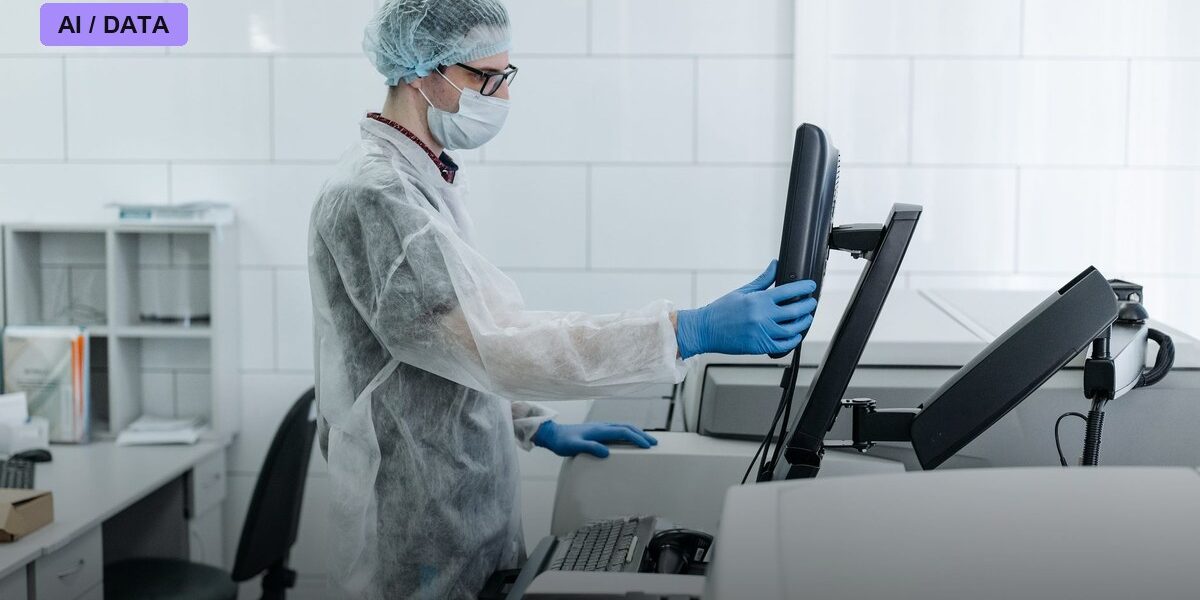
Photo: Pavel Danilyuk / PEXELS via Pexels