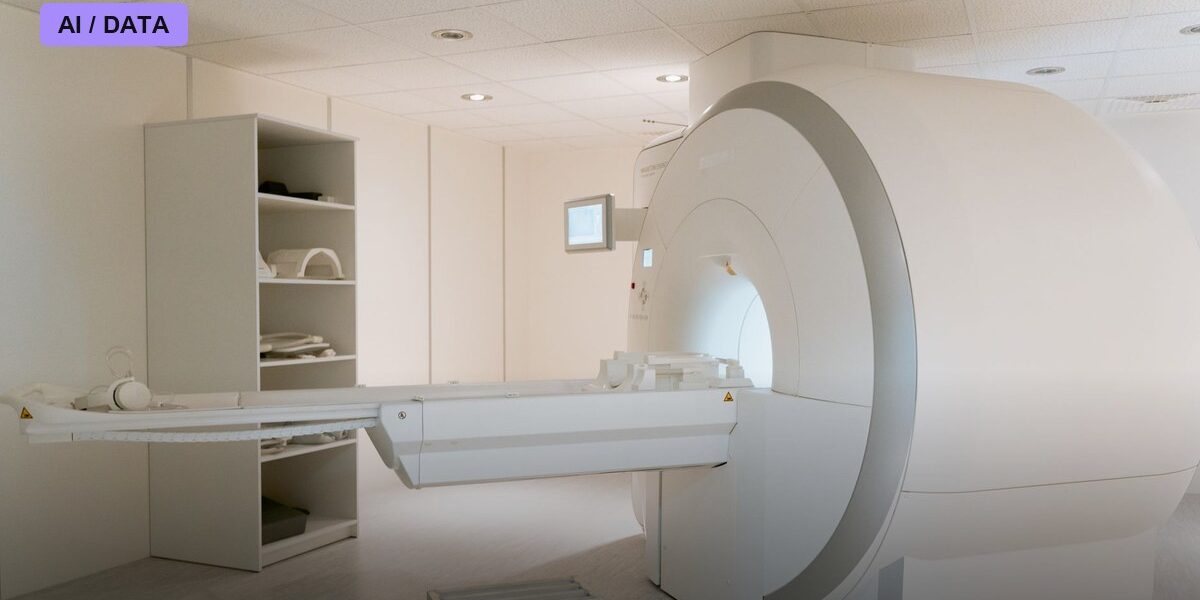
Hyperfine, the Connecticut-based maker of the Swoop portable brain MRI system, has secured a new FDA clearance for an updated version of its Optive AI software, the artificial intelligence engine that reconstructs and sharpens images captured by its bedside scanner. The clearance, reported in trade press in August 2026, marks the second FDA-cleared software package the company has shipped since its next-generation Swoop hardware launched in mid-2025, underscoring how quickly point-of-care imaging AI is iterating compared with traditional fixed MRI suites that can go years between major software upgrades.
What the New Clearance Covers
The updated Optive AI package builds on the version first cleared in May 2025, which Hyperfine described at the time as its tenth software release for the Swoop platform. The newer clearance adds a 3D imaging sequence intended to give clinicians fuller spatial visualization of brain structures, along with what the company says is improved image quality in challenging clinical environments, such as at a patient’s bedside in an intensive care unit rather than inside a shielded radiology suite. Hyperfine has also said the update makes the scanning workflow more intuitive for technologists who may not be dedicated MRI specialists.
How Portable MRI Fits Into AI-Enabled Imaging
Swoop is a low-field MRI system, using a far weaker magnet than the 1.5-tesla or 3-tesla machines found in most hospital radiology departments. That lower field strength traditionally produced noisier, lower-resolution images, which is precisely the gap Optive AI is built to close through noise cancellation, reconstruction, and post-processing techniques. Hyperfine and partner clinical sites have described image quality now approaching that of conventional 1.5T scanners, though that characterization comes from the company and its collaborators rather than from independently published, peer-reviewed comparisons.
Part of a Fast-Moving FDA Pipeline for AI Devices
Hyperfine’s repeat clearance lands amid a historically active stretch for AI-enabled medical device authorizations broadly, with industry trackers citing dozens of new 510(k) clearances and De Novo classifications for AI and machine-learning devices in recent quarters. Portable and point-of-care imaging has become one of the more active sub-categories, as device makers compete to bring diagnostic-grade imaging out of centralized radiology departments and closer to where patients are actually being treated, whether that is an emergency department, a rural clinic, or a battlefield.
Why Bedside Imaging Matters for Stroke and Trauma Care
The clinical case for portable MRI centers on time. In suspected stroke cases, the interval between symptom onset and imaging can determine whether a patient is eligible for clot-busting drugs or other time-sensitive interventions, and transporting a critically ill patient to a fixed MRI suite can introduce delay and risk. By bringing a lower-cost, lower-power scanner to the bedside, Hyperfine argues hospitals can image patients sooner after a neurological event, with AI reconstruction compensating for the image-quality tradeoffs of a weaker magnet.
The Skeptical Read
Radiologists and imaging specialists have cautioned that portable low-field MRI, even with AI enhancement, is not yet a wholesale replacement for conventional MRI in cases requiring the finest anatomical detail, such as detecting very small lesions or subtle early-stage abnormalities. The absence of independent, peer-reviewed head-to-head studies comparing Optive AI-enhanced Swoop images against standard 1.5T or 3T scans leaves open questions about where the technology’s diagnostic ceiling sits, even as the FDA clearance confirms the software met the agency’s bar for safety and substantial equivalence to prior cleared versions.
What Comes Next
Hyperfine has said it planned to begin rolling the updated software out to existing and new Swoop customers in the weeks following the August 2026 clearance. With a now-established cadence of incremental FDA clearances roughly every few months, the company’s trajectory will likely keep shaping how quickly portable, AI-assisted imaging moves from a niche tool in select stroke centers toward broader adoption across emergency departments, rural hospitals, and military and disaster-response settings where a fixed MRI suite simply is not an option.
Hospital procurement teams evaluating Swoop have told trade press that cost remains as much a factor as image quality: a low-field portable system runs a fraction of the price of a conventional fixed MRI installation, both in upfront capital and in the specialized shielded rooms and cryogenic cooling infrastructure a full-strength magnet requires. That cost gap is part of why Hyperfine has focused its AI investment on closing the image-quality shortfall through software rather than through more expensive magnet hardware, a bet that each successive Optive AI clearance is effectively a test of.
The company has not disclosed specific sales or installed-base figures tied to this latest clearance, and independent analysts note that broader hospital adoption of point-of-care MRI will likely depend as much on reimbursement clarity from Medicare and private payers as on any further image-quality gains, since many hospitals remain uncertain how bedside scans will be billed relative to traditional radiology-department imaging.
Photo: MART PRODUCTION / PEXELS via Pexels