One of AI’s most practical wins is happening in the most everyday place: the weather forecast. AI-driven models now outperform traditional numerical forecasting on roughly 90% of metrics — and in 2026 the upstarts are beating the government agencies that have long set the standard.
The startups pull ahead
The clearest sign of the shift: WindBorne Systems released a tool offering more frequent and accurate predictions on key variables than the world-leading system run by European governments. Its sixth-generation WeatherMesh model is more accurate than both traditional forecasts and rival AI forecasts produced by the European Centre for Medium-Range Weather Forecasts (ECMWF) — the long-time gold standard. When a startup out-forecasts ECMWF, the old hierarchy is genuinely changing.
Physics-aware AI
The best new models do not just pattern-match the past. Jua’s EPT-2, a spatiotemporal transformer foundation model, was trained on more than 5 petabytes of weather and climate data from over 120 sources and uses a physics-constrained approach — embedding conservation laws so its outputs stay consistent with real atmospheric physics. That tackles ‘hallucination,’ the risk that a model produces a plausible-looking forecast that violates how the atmosphere actually works.
Governments adapt
The establishment is not standing still. NOAA has begun deploying a new generation of AI-driven global weather models, signaling that public agencies see AI as the future of operational forecasting rather than a threat to it. The likely outcome is hybrid: AI speed and accuracy layered on top of decades of physical modeling and observation networks.
The stubborn weakness
There is an important caveat. AI models still underperform on extreme events — record-breaking heat, cold and wind — where leading models like GraphCast, Pangu-Weather and Fuxi trail ECMWF’s traditional HRES system. And crucially, these are forecasting tools for the 0-15 day window, trained on historical data; they are not climate models and cannot project long-term shifts in temperature, sea level or precipitation. Mistaking one for the other would be a serious error.
Why it matters
Better, faster, cheaper forecasts ripple everywhere — farming, aviation, energy, disaster preparedness. Earlier and more accurate warnings save lives and money. But the extreme-event gap matters most precisely when forecasts matter most, which is why human meteorologists and physical models remain essential partners to the AI.
The bottom line
AI has quietly become the most accurate way to forecast the weather, with startups now besting Europe’s best. The technology is a genuine, practical triumph — as long as users remember its limits at the dangerous extremes, and never confuse a 15-day forecast for a climate projection.
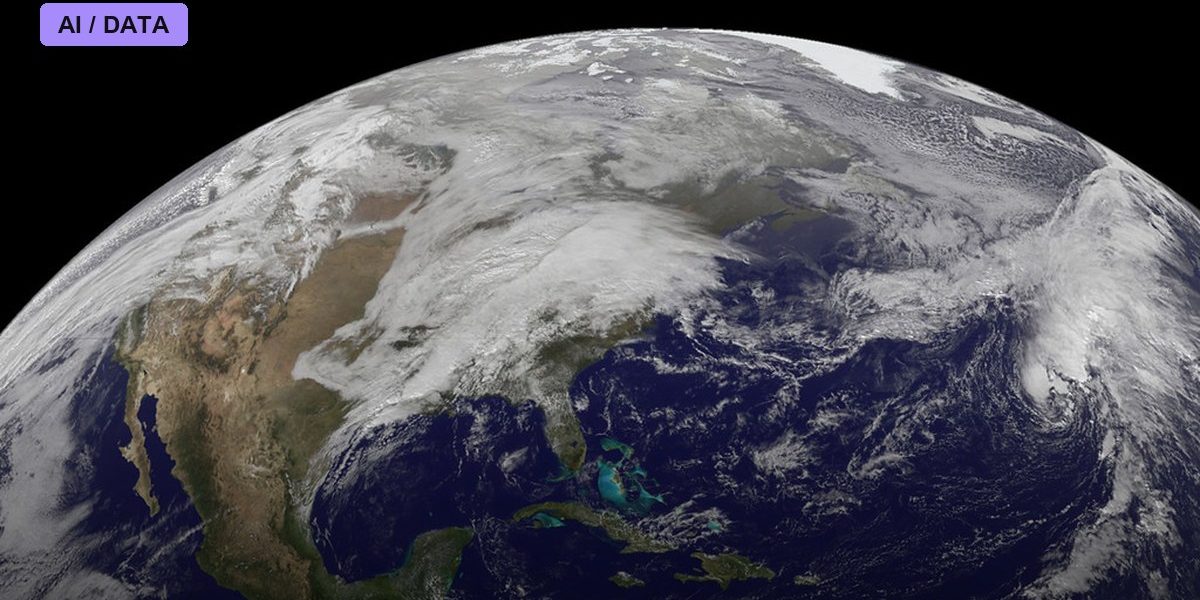
Photo: NASA Goddard Photo and Video / BY via nasa